
Two popular investment vehicles for investors looking to diversify their portfolios are index funds and exchange-traded funds (ETFs). While they share some similarities, they also have key differences that can significantly impact your investment strategy. Understanding these differences is crucial to ensure they align with your investment strategy. This article will delve into index funds vs ETFs, how they differ, and the pros and cons of each.
What is an Index Fund?
An index fund is a type of mutual fund designed to replicate the performance of a specific market index, such as the S&P 500 or the Dow Jones Industrial Average. These funds are passively managed, meaning that the fund manager’s role is to mirror the index’s composition rather than actively selecting stocks. The primary goal is to achieve the same return as the index it tracks, minus any fees.
How do Index Funds Work?
Index funds buy and hold all (or a representative sample) of the securities in the index they follow. This approach ensures that the fund’s performance closely tracks the index’s performance. For example, if the S&P 500 gains 10% in a year, an S&P 500 index fund aims to provide a similar return.
What is an ETF?
An exchange-traded fund (ETF) is similar to an index fund in that it aims to replicate the performance of a specific index. However, unlike index funds, ETFs are traded on stock exchanges like individual stocks. ETF prices fluctuate throughout the trading day based on supply and demand.
How do ETFs Work?
ETFs hold a basket of assets, such as stocks, bonds, or commodities, that replicate an index’s performance. They are designed to offer investors the benefits of diversification, similar to mutual funds, but with the flexibility of stock trading. Investors can buy and sell ETF shares throughout the day at market prices.
Key Differences Between Index Funds and ETFs
Trading Flexibility
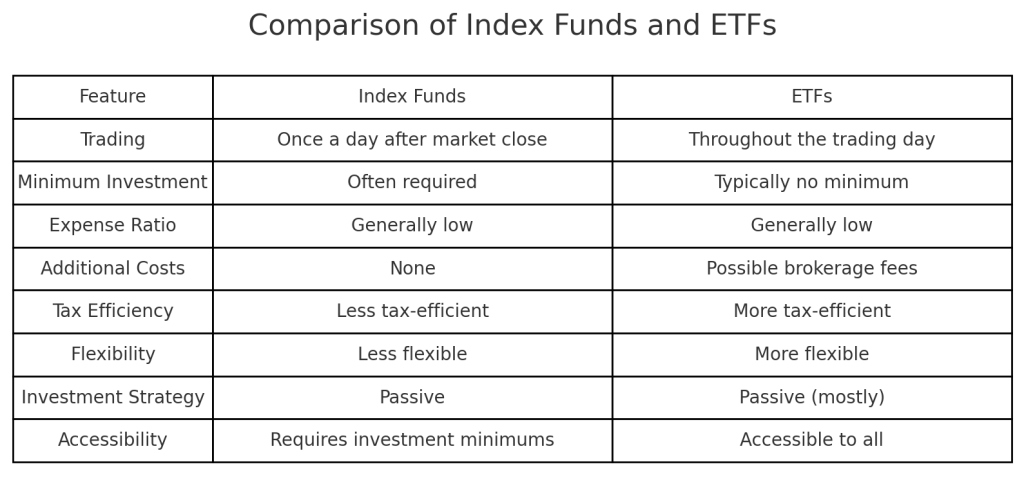
One of the most significant differences between index funds and ETFs is their trading flexibility. Index funds are priced once a day after the market closes, and investors can only buy or sell shares at that price. In contrast, ETFs can be bought and sold at market prices throughout the trading day, providing investors with greater flexibility and control over their trades.
Minimum Investment Requirements
Index funds may have minimum investment requirements ranging from a few hundred to several thousand dollars. This can be a barrier for some investors, particularly those just starting. ETFs, on the other hand, typically do not have minimum investment requirements. Investors can buy as few or as many shares as they want depending on their portfolio size.
Cost Structure
Both index funds and ETFs are known for their low costs compared to actively managed funds, but there are some differences in their fee structures. Index funds generally charge an annual expense ratio, which covers the cost of managing the fund. ETFs also have expense ratios, but they may have additional costs, such as brokerage fees for buying and selling shares. However, many brokers now offer commission-free ETFs, reducing this cost barrier.
Tax Efficiency
Due to their unique structure, ETFs are generally more tax-efficient than index funds. When investors sell ETF shares, they typically do so on the open market, which doesn’t force the ETF to sell underlying assets and trigger capital gains taxes. In contrast, index funds may need to sell securities to meet redemption requests, potentially creating capital gains that are passed on to all shareholders.
Pros and Cons of Index Funds
Pros of Index Funds
- Simplicity: Index funds are straightforward and easy to understand. They track a specific index and aim to replicate its performance, making them an excellent choice for novice investors.
- Low Fees: Since they are passively managed, index funds typically have lower fees than actively managed funds.
- Diversification: By investing in an index fund, investors gain exposure to a broad range of securities, reducing the risk associated with individual stocks.
- Consistency: Index funds aim to match the performance of the index they track, providing consistent and predictable returns over the long term.
Cons of Index Funds
- Limited Flexibility: Index funds can only be traded once a day at the closing price, limiting investors’ ability to react to market changes or trade with maximum efficiency.
- Potential for Underperformance: While index funds aim to match the performance of their index, they do not seek to outperform it. This means they may underperform in bullish markets compared to actively managed funds.
- Minimum Investment Requirements: Many index funds have minimum investment requirements, which can be a barrier for some investors.
Pros and Cons of ETFs
Pros of EFTs
- Trading Flexibility: ETFs can be bought and sold throughout the trading day, allowing investors to react quickly to market changes and take advantage of intraday price movements.
- Lower Minimum Investments: ETFs typically do not have minimum investment requirements, making them accessible to a broader range of investors.
- Tax Efficiency: The structure of ETFs generally makes them more tax-efficient than mutual funds, potentially reducing investors’ tax liabilities.
- Variety: There is a wide variety of ETFs available, covering different sectors, asset classes, and investment strategies, providing investors with numerous options to diversify their portfolios.
Cons of EFTs
- Trading Costs: Although many brokers offer commission-free ETFs, some may still have trading costs, particularly for frequent traders.
- Price Fluctuations: Since ETFs are traded like stocks, their prices can fluctuate throughout the day, which may lead to buying at a premium or selling at a discount to the net asset value (NAV).
- Complexity: ETFs can be more complex than index funds due to their trading mechanics and the variety of investment strategies they may employ, which can be overwhelming for novice investors.
Index Funds or EFTs?
Choosing between index funds and ETFs depends on your investment goals, preferences, and trading habits. If you prefer simplicity, lower fees, and are investing for the long term without the need for intraday trading, index funds may be the better choice. On the other hand, if you value trading flexibility, lower minimum investments, and potential tax advantages, ETFs might be more suitable.
Both index funds and ETFs offer unique benefits and can be valuable additions to an investment portfolio. Understanding their differences and their pros and cons can help you make informed decisions that align with your financial goals. If you need assistance reviewing your portfolio and determining whether index funds or ETFs make more sense for your situation, schedule a free consultation today!